Latest
Malin Starrett, 2026, The history of science in Ireland – why the neglect? (History Ireland). “The Queen’s University department closed many years ago and no other university on the island of Ireland has a History of Science department.”
Newell, et al., 2026, Analysis of trade unions’ perspectives on AI’s impact (TASC)
Gibbins, 2025, The Lie of the Land: the Truth About Farming, Climate and Power in Ireland
Bresnihan and Brodie, 2025, From the Bog to the Cloud: Dependency and Eco-Modernity in Ireland (also see video “From the Bog to the Cloud: Dependency and Eco-Modernity in Ireland“). “FDI [foreign direct investment] nationalism…Ireland’s greatest resource is FDI.”
Coleman, 2025, Turf in electricity generation 1945-2000, in: Management and Administration Journal
Allen and O’Boyle, 2021, Tax Haven Ireland
History of Science, Technology & Medicine Network of Ireland
2010-2020
Cunningham, et al., 2020, Evolution of Ireland’s industrial, science and technology policy, in: Annals of Science and Technology Policy
Brosnan, 2019, Measuring and evaluating economic impact of publicly-funded research centres (University College Cork). “Research policy in Ireland was significantly underdeveloped relative to other developed economies in Europe during the 1980s and 1990s. It was only in 1996, following the publication of the White Paper on Science, Technology and Innovation that the Irish Government first made focused efforts on developing a knowledge-based economy.”
Walsh, 2018, Higher Education in Ireland, 1922–2016: Politics, Policy and Power
Eunan O’Halpin, 2018, Ireland Looking Outwards 1880-2016, in: Cambridge History of Ireland
Interim Evaluation of Science Foundation Ireland Research Centres Programme, Indecon International Research Economists, 2017. “This interim evaluation suggests that the Research Centre Programme has met or exceeded most of the targets set. They have been successful in leveraging additional resources from industry and other sources including the EU.”
McGarrigle, 2017, The establishment of the Dublin Institute of Advanced Studies 1936-1948
Weng, 2016, Irish modernism and the machine (University of Illinois Urbana-Champaign)
Oppenheimer, 2016, IRA: the Bombs and the Bullets: a History of Deadly Ingenuity
*Derek Jan Fikkers and Matthias Ploeg, 2015, Strengthening Ireland’s Market-Focused Research Centre Landscape Roadmap for the further development of market-focused research centres in Ireland (Technopolis Group). “At the beginning of 2015, Ireland’s market-focused research centre landscape consists of twelve SFI Research Centres, fifteen EI/IDA Technology Centres, and a group of sector-specific centres, more specifically Teagasc (agriculture & food research), Tyndall Institute (information and communications technology research) and NIBRT (bioprocessing research and training)…the centres in Ireland at the aggregated level focus on the low TRL levels (<4). Irish companies needing research and development that is more mature than TRL5 depend on the small EI/IDA Technology Centres’ and Technology Gateway capacity, and on sector oriented research capacities in Teagasc, Tyndall, and NIBRT.”
Hazelkorn, 2015, Restructuring Irish Higher Education, in: International Higher Education
Gary A. Boyd and John McLaughlin (eds.), 2015, Infrastructure and the Architectures of Modernity in Ireland 1916-2016
Ronan Fanning, 2015, Éamon de Valera: a Will to Power
O’Boyle, 2013, Austerity Ireland: the Failure of Irish Capitalism
Andy Bielenberg and Raymond Ryan, 2013, An Economic History of Ireland Since Independence
Garrett Carr, 2011, The map of watchful architecture, in: EchoGéo
Rubenstein, 2010, Public works: infrastructure, Irish modernism, and the postcolonial
Clarke, 2010, Brown Gold: a History of Bord Na Móna and the Irish Peat Industry
2000-2010
Duncan, 2009, Transformations: how research is changing Ireland
*Harvie, 2008, Aftermath: “Nights Candle’s are Burnt Out” in: A Floating Commonwealth: Politics, Culture, and Technology on Britain’s Atlantic Coast, 1860-1930
An Board Snip Nua, 2008, Report of the Special Group on Public Service Numbers and Expenditure Programmes, vol. 2
Shay Healy, 2005, The Wiremen
Ó Riain, 2004, The Politics of High-Tech Growth: Developmental Network States in the Global Economy
*Attis and Mollan, 2004, Science and Irish culture, vol. 1 and vol. 2
Roy H. W. Johnston, 2003, Century of Endeavour: A Biographical and Autobiographical View of the Twentieth Century in Ireland
Mary L. Mulvihill, 2003, Ingenious Ireland: A County-by-County Exploration of the Mysteries and Marvels of the Ingenious Irish
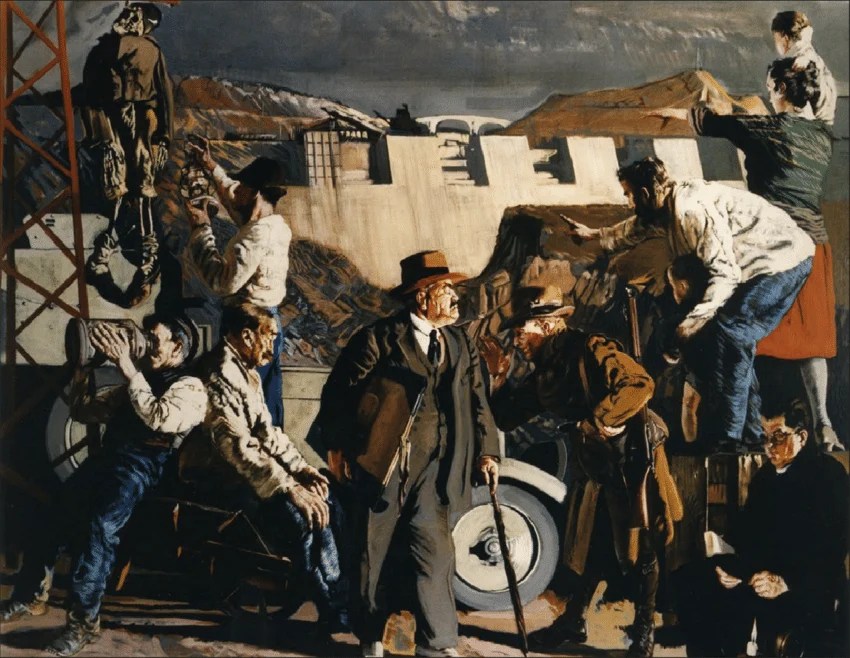
Bielenberg, 2003, The Shannon Scheme And the Electrification of the Irish Free State (see also O’Brien, 2017, Powering the Nation: Images of the Shannon Scheme and the Electrification of Ireland)
Eunan O’Halpin, 2002, Irish neutrality in the Second World War, in: European Neutrals and Non-belligerents during the Second World War
1990-2000
Whyte, 1999, Science, colonialism, and Ireland
Roy Johnston, JD Bernal – some Irish influences, in: Notes and Records of the Royal Society. Roy H. W. Johnston (1929-2019) was a physicist, Republican and Marxist (inspired by J.D. Bernal); he wrote prolifically about Irish science and technology through the second half of the 20thC.
Greta Jones, 1997, Catholicism, Nationalism and Science, in: Irish Review
*Cormac Ó Gráda, 1997, A Rocky Road: the Irish Economy since the 1920s. “Mr Lemass opens a new factory for making keys for opening new factories, Dublin Opinion, October 1935” (p. 113)
Sean Lysaght, 1996, Themes in Irish History of Science, in: Irish Review
ESB, 1996, Death of the Banshee – the Story of Rural Electrification Institution [film]
Mike Cooley, 1994, Saoirseacht nó sclábhaíocht?
Ó Gráda, 1994, Ireland: a new economic history, 1780-1939
J. Bowyer Bell, 1993, The Irish Troubles: a Generation of Violence, 1967-1992
Grimes, 1992, Information technology and regional development: the Irish experience, in: NETCOM
*Mary E. Daly, 1992, Industrial Development and Irish National Identity, 1922-1939
J. Bowyer Bell, 1990, IRA Tactics and Targets: an Analysis of Tactical Aspects of the Armed Struggle 1969-1989. “The covert world of the IRA is inefficient, demanding, dangerous, no place for elaborate plots or operations more suitable for…articles in scholarly books on hi-tech terror. Anthrax and arsenic are alien; an IRA nuclear device is ludicrous…quite literally no serious thought to biological warfare, gas or poison, much less radiation. And even the hi-tech nodes in post western societies, the keys of command and control run by computers, the technological links, the records on silicon chips, the control of air traffic, all the targets of the theorists, have been beyond serious consideration…the organization lacks native hi-tech skills or access to congenial experts. [But o]ne effort was made to construct missiles in America.” (pp. 49-50)
Before 1990
Dorinda Outram, 1986, Negating the natural: or why historians deny Irish science, in: Irish Review
*Shiel, 1984, The quiet revolution: The electrification of rural Ireland 1946–1976
Manning and MacDowell, 1984, Electricity Supply in Ireland: The History of the ESB
Mike Cooley, 1982, Architect or Bee?: The Human/technology Relationship
RTÉ, 1980, The Electric Car Of The Future, Ireland 1980 [film]
Ackroyd, et al., 1977, The Technology of Political Control
OECD, 1974, Reviews of National Science Policy: Ireland
Michael Woods, 1970, Research in Ireland: Key to Economic and Social Development
ESB/RTÉ, Forty Light Years from Parteen, 1967 [film]
OECD, 1966, Science and Irish Economic Development: Report of the Research and Technology Survey Team Appointed by the Minister for Industry and Commerce in November 1963
Anon., 1959, Research on Turf in Ireland, Bord na Móna
