What does science and research look like in crises?

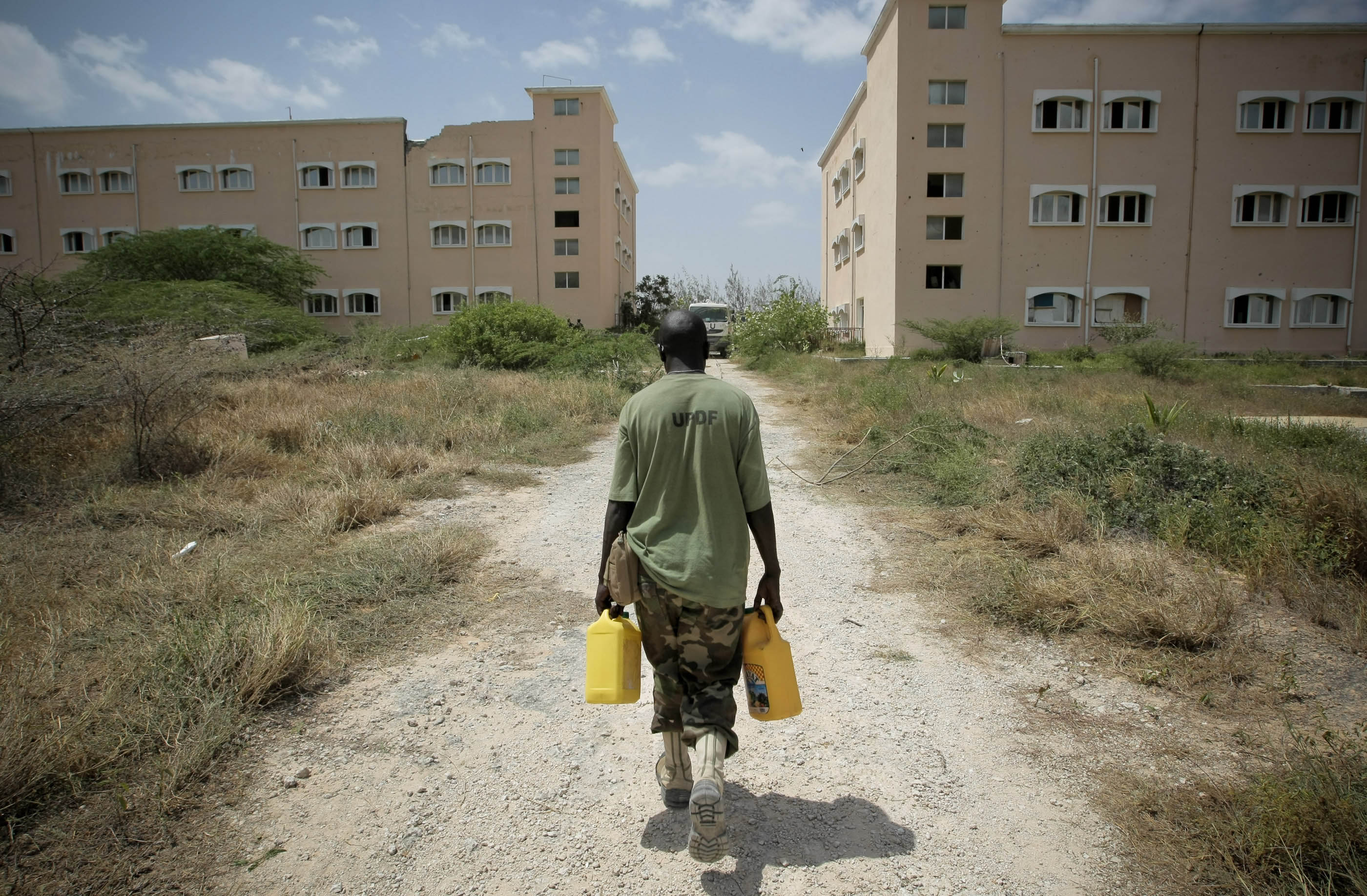
Mogadishu University in 2012 with an individual from the Uganda Defense Force in the foreground. Photograph supplied by the African Union Mission in Somalia (AMISOM).

When we talk about science and research in relation to crises, we typically mean solutions to crises by scientific means. This has obviously produced a significant amount of literature such as the covid crisis.

Another less mainstream reading, and the one I will pursue in this report, is what happens to scientific institutions when they experience major crises, i.e., when they come up against forces greater than themselves.

A large-scale example would be the crisis of science and research in eastern Europe in the last decade of the twentieth century, following the collapse of regimes in those countries. There was indeed a instructive literature analyzing this topic in the 1990s, led by such analysts as Dr. Raymond Bentley and Prof. Dr. Werner Meske, which we will revisit.

For the first section of this report, I will interview a handful of scientists in Europe, Asia, and Africa who have had to deal with recent crises to find out what they think about them. In most parts of the world, science and research is, arguably, in permanent crisis due to lack of funds.

Then I will look at a few varied historical examples, such as we can know them, to ask how major crises have impacted science and research in the past 50 years. I shall draw some tentative conclusions at the end.

Where do we set the boundaries of the crisis? In other words, when did a previous state of equilibrium, so perceived, get disrupted, when did that phase of disruption end, and when was a new state of equilibrium established?

I would not define crises; I let the interviewees speak for themselves and, in terms of the historical examples, I define them as crises because they are typically discussed as such.

My main goal is to estimate what we might, realistically, expect from science and research under the present circumstances, which, according to some commentators, is an era of permanent crisis. Furthermore, what, if any, data, could we use to inform projects such as reconstruction of science and research in former war zones, when the guns fall silent?

The report is currently in the data-gathering phase. Publication expected in 2027.

Big crises since 1972: putative correlations on science and research in Europe (provisional)

CrisisShort-term correlatesLong-term correlates
Oil crises of the 1970sInitially, renewed interest in RD&D related to renewable energy; but halfhearted investment followed until about 1980, then switched back to oil and gas recovery techniques (nuclear research also curtailed due to disasters).(1)Renewable energy technology was under-developed and reliant on RD&D by enthusiasts in the private sector and outside Europe, notably in China (think of solar cells and LED bulbs).(2) Technology became deploy-able too late to have the greatest impact on climate change.
Crises of the 1980/1990sBreak-up of applied RD&D centers in both private and privatized industries (in some cases, the end of the corporate lab).(3) State capacity deficits/lack of preparation associated with stuttering responses to HIV/AIDS and mad cow disease. Probably also exacerbated the many big industrial and transport accidents of the period.(4)Some reconstruction of state expertise in late 1990s/early 2000s such as in food and workplace health and safety regulation.(5) SARS crisis stimulated pandemic preparations which were later forgotten. Rebuilding of state RD&D in selected areas notably military (the latter after 11 September 2001 attacks).
Collapse of Communism in eastern Europe post-1989New intellectual freedoms matched with sometimes chaotic restructuring of science and research capacity (although exact details varied widely between countries). Exception of East Germany, where the science and research system was restructured in a more planned way.(6)Brain drain. End of the technical middle class as previously known. Scientific capacity gradually rebuilt in some areas but in many others left to decline further with various knock-on effects.
2008 financial crisisHollowing out of state capacity in science and research initially only in some countries such as Greece and Spain, but then spreading to other parts of Europe.(7) Nowhere was there an increase in expenditure. Cuts were accompanied by talk about the importance of innovation.The failure of states to stop the spread of covid, given their long-standing role in infectious disease control, is eye opening and not easy to lay entirely at the door of viral biology (some states in East Asia did manage to stop the virus spreading). Prior austerity policies probably need to be closely examined.
(1) Dooley, 2010, The Rise and Decline of US Private Sector Investments in Energy R&D since the Arab Oil Embargo of 1973, US DOE, p. 12. Graf, 2014, Claiming Sovereignty in the Oil Crisis “Project Independence” and Global Interdependence in the United States, 1973/74. Westwick, 2003, The National Labs: Science in an American System, 1947-1974. Ramunni and Deflandre, 2001, ‘Faire face à la crise du pétrole : l’énergie solaire au CNRS’, in: Revue pour l’histoire du CNRS. Wilson, 2012, A history of the UK renewable energy programme, 1974-88: some social, political, and economic aspects, PhD thesis. Kemp, 2013, The Official History of North Sea Oil and Gas, vol 1. Kolb, 2013, The Natural Gas Revolution: At the Pivot of the World’s Energy Future. Topçu, 2010, L’agir contestataire à l’épreuve de l’atome: critique et gouvernement de la critique dans l’histoire de l’énergie nucléaire en France (1968-2008), PhD thesis (EHESS). Griliches, 1980, R&D and the productivity slowdown, Working Paper No. 434, National Bureau of Economic Research. Venn, 2002, The Oil Crisis (pp. 58-59). Burn, 1978, Nuclear Power and the Energy Crisis: Politics and the Atomic Industry. Bobrow & Kudrle, 1979, Energy R&D: in tepid pursuit of collective goods, in: International Organization. Wong, et al., 2013, Energy consumption and energy R&D in OECD: Perspectives from oil prices and economic growth, in: Energy Policy. (2) The story of Shi Zhengrong, and the broader Chinese role in solar cells, is famous. The part played by the Research Institute of Tsinghua University in Shenzhen in the development of modern LED bulbs is probably less well-known but also crucial. The two kinds of device represent seminal Chinese contributions to science and technology over the last couple of decades. (3) Referring to the UK, it is said that ‘industrial R&D employment’ fell by 6.1% between 1980 and 1988, i.e., from 195k to 183k (Howells, 1992, ‘Patterns of research and development’, in: Regional Development in the 1990s: the British Isles in Transition). See also: Heim, 1988, ‘Government research establishments, state capacity, & distribution of industry policy in Britain’, in: Regional Studies; Parker, 2009/2013, The Official History of UK Privatization; Helm, 2004, Energy, the State, and the Market: British Energy Policy Since 1979; Mirowski, 2010, Science Mart; Busch, 2014, Le marché aux connaissances: néolibéralisme, enseignement et recherche; Agar, 2019, Science Policy under Thatcher. (4) Jasanoff, 1986, Risk Management and Political Culture; Jasanoff, 1994, Learning from Disaster: Risk Management After Bhopal; Berridge, 1996, AIDS in the UK: The Making of Policy, 1981-1994; Jasanoff, 1997, ‘Civilization and madness: the great BSE scare of 1996’, in: Public Understanding of Science; Beaud, 1999, Le sang contaminé: essai critique sur la criminalisation de la responsabilité; Cummings, 2010, Rethinking the BSE Crisis: A Study of Scientific Reasoning under Uncertainty. (5) Majone, 1994, The rise of the regulatory state in Europe, West European Politics; Ansell and Vogel, 2006, What’s the Beef?: The Contested Governance of European Food Safety; Lang and Heasman, 2004, Food Wars: The Global Battle for Mouths, Minds and Markets (p. 278). (6) Reynolds, 2010, ‘Science, technology, and the Cold War’, in: Cambridge History of the Cold War. Carter & Turnock, e.g., Environmental Problems in Eastern Europe (1993); Meske, et al., 1997, Die Integration von ostdeutschen Blaue-Liste-Instituten in die deutsche Wissenschaftslandschaft. Meske, 1998, Institutional transformation of S&T systems in the European economies in transition: Comparative analysis, WZB Discussion Paper. Hodges (2017) Cosmologies in Transition: Science & the Politics of Academia after Yugoslavia. Pavlínek, 2008, A Successful Transformation?: Restructuring of the Czech Automobile Industry (p. 218). Brill, 2017, Von der Blauen Liste zur gesamtdeutschen Wissenschaftsorganisation: Die Geschichte der Leibniz-Gemeinschaft. Commission of the European Communities, 1992, Cooperation in the field of science & technology between the European Community & the countries of Central & Eastern Europe, SEC(92) 785. Baltes, 2017, The critical situation of R&D in Romania: the main cause of the Romanian researchers’ migration, in: Marinescu, p. 225. COM(94) 420. Meske, 2004, From System Transformation to European Integration: Science and Technology in Central and Eastern Europe at the Beginning of the 21st Century. Tatalović & Dauenhauer, 2019, Physics in the former Yugoslavia: from socialist dreams to capitalist realities, in: Physics Today. Balázs, et al., 2014, 25 years after the fall of the Iron Curtain: the state of integration of East and West in the European Union, European Commission DG for Research & Innovation. Egorov, 2002, Perspectives on the Scientific Systems of the Post-Soviet States: a Pessimistic View, in: Prometheus: Critical Studies in Innovation. Schimank & Lange, 1998, Wissenschaft in Mittel- und Osteuropa: Die Transformation der Akademieforschung, in: Leviathan. Etzkowitz, 1996, Losing our bearings: the science policy crisis in post-Cold War Eastern Europe, former Soviet Union and USA, in: Science and Public Policy. Oral history interviews with German scientists reflecting on the experience of the restructuring of DDR scientific institutions after 1989. (7) Izsak and Radosevic, 2017, ‘EU research and innovation policies as factors of convergence or divergence after the crisis’, in: Science and Public Policy. Izsák, Markianidou, Lukach and Wastyn, 2013, The impact of the crisis on research and innovation policies (study for the European Commission DG Research by Technopolis Group Belgium and Idea Consult). Makkonen, 2013, ‘Government science and technology budgets in times of crisis’, in: Research Policy. Filippetti and Archibugi, 2011, ‘Innovation in times of crisis: national systems of innovation, structure and demand’, in: Research Policy. Kastrinos, 2013, The financial crisis and Greek R&D policy from a Schumpeterian perspective, in: Science and Public Policy. Cruz‐Castro and Sanz‐Menéndez, ‘The effects of the economic crisis on public research: Spanish budgetary policies and research organisations’. These articles refer to R&D not scientific activities in general such as support for regulation, healthcare or other public services but the pattern is relatively clear.

Reinecke, 2022, When funding fails: Planetary exploration at NASA in an era of austerity, 1967–1976, in: Social Studies of Science

Anderson, 2021, The model crisis, or how to have critical promiscuity in the time of Covid-19, in: Social Studies of Science

Margócsy, 2017, A long history of breakdowns: A historiographical review, in: Social Studies of Science

Leave a Comment