If Europe is to push ahead with its low-carbon goals, it will need to expand the currently marginal involvement of Chinese companies in both the deployment and manufacture of the relevant technologies. These include solar photovoltaics, wind turbines and batteries.
Andrews-Speed, 2025, The international implications of China’s roles in the low-carbon energy transition (LSE IDEAS)
Summary
How is the EU to equip itself for a low-carbon energy system? The collapse of battery firm Northvolt, the seeming abandonment of the green agenda, and the Draghi report, with its doomladen prognostications, all swirl around this question. The background: an “energy crisis” that led to economic damage, immiseration, sickness and even deaths in households unable to afford adequate heating.
The lessons of Northvolt, according to a 2024 analysis by Tagliapietra and Trasi (Bruegel) were the need to build a “diversified ecosystem of ventures, rather than relying on champions”, “strategic partnerships with Chinese and other Asian firms” and “lower energy prices and developing skills and capital markets”. These remarks seem to have been repeated by other analysts, e.g., a more recent report by Andrews-Speed.
My own analysis reveals that Europe is making a number of meaningful investments along those lines (detailed below). However, as an example, I also calculated that 78% of funds in the ETS Innovation Fund are going to fossil fuel incumbency (ammonia, CCS, hydrogen, pyrolysis, SAF). This is against 15% to proven, scalable, alternatives, such as batteries, solar PV and wind turbines.
Misallocation of funds has to be accepted in all policy programs, but when such a large proportion is poured into incumbency at the project selection stage, innovation faces an uphill struggle.
Emergent policy
The focus in what follows has been subsidization relevant to R&D and manufacturing of batteries, solar PV and wind turbines. This forms a relatively smaller part of the budgetary pie but has the greatest potential. The core bureaucratic factors in my picture include (national) state aids, cohesion policy, EIB operations, Horizon Europe and the ETS Innovation Fund.
It is evident that Europe subsidizes an undeclared “portfolio” of relevant manufacturing industry that includes affiliates of multinational firms such as Sibanye-Stillwater and Imerys in mining, Bolloré in chemicals and Stellantis, Mercedes-Benz and Renault in automotive. Many specialized firms are also involved. Subsidization is a mix of new manufacturing facilities, manufacturing upgrades, and (relatively cheaper) RD&D and information exchange mechanisms such as a “competence cluster“.
Because the investments I have described are not a portfolio in the conventional sense, there is no formal mechanism to detect ownership of the firms involved. But, based on my own research, the “nationalities” include Europe, South Africa and the USA, but Asia is probably the most frequent outside Europe. If there is one split within this putative subsidization regime, it is between cooperation with Chinese (and also South Korean and Taiwanese) firms in batteries and solar photovoltaic, but not in wind turbines.
Europe’s “subsidization regime” by national origin of recipient (examples)*
| Asia | Europe | USA | |
|---|---|---|---|
| Batteries | Bluestar, Envision AESC, Sunwoda, LG, ProLogium, Geely† | ALSTOM, Atnom, Gränges Finspång, Leclanché, Olympia, Sekai, Skeleton, Schneider Electric-Renault (etc.), Stellantis-Total-Mercedes-Benz, THWAICE, Total-PSA-Opel, Valeo | Lyten††, T1 |
| Solar PV | Trina, QCells | Armor, Enel, FuturaSun, Meyer Burger, Midsummer, Mondragon | – |
| Wind turbines | – | Acciona, Norvento, Siemens Gamesa, Vestas, Windar, Windwise | Aerones, Flender¶ |
Ryder Cup of Wind
Chinese wind turbine makers are reportedly taking steps to create European manufacturing sites. However, there are also moves into the wider customs union, namely, Turkey, giving access to the European market. Perhaps such manufacturing will follow the pattern of “integrated periphery” seen in other sectors.
Atlantic-minded think tanks such as the European Council on Foreign Relations promote the idea that the EU ought to work with the USA, India and the UK to resist the Chinese wind industry, suggesting it is the “last gasp” for Europe.
The USA certainly has an insatiable urge to portray China as a threat. Over more than 20 years, the EU has also spent weighty amounts, exceeding 1.5bn Euro, financing R&D in wind turbine firms operating within its own borders. The Commission repeatedly wheeled out a stock tactic: legal embroilment for firms, in this case, Chinese wind turbine manufacturers, on grounds they had been excessively subsidized.
EIB financing of R&D in European wind turbine firms (2004-present)
| Firm | Finance |
|---|---|
| Vestas | 725m |
| Siemens Gamesa | 690m |
| Nordex | 100m |
Logically, we ought to ask what remedy is apt in light of overarching policy goals, whether that be aligning with America, developing an independent technology policy, decarbonization, societal priorities, open innovation, cooperation with China, or some other goal.
A wind turbine manufacturing policy aligned with the USA might have upsides if the North American market expanded and European firms were given priority access to it, but it would have downsides if it turned out the Chinese devices were better, while priority access to the North American market was denied. Chinese manufacturers were traditionally “behind” in fields such as doubly-fed systems required for offshore wind farms but expertise changes rapidly.
European policy predicated on indigenous but over-priced, sub-par equipment would make the continent poorer, not richer (which unfortunately has happened in the past). The political risk for Brussels is that member states pull away from EU S&T policies (of course, no one would reject EU funds but they might not “buy” into the rest). Other S&T policies, such as closer alignment with China, are available.
Down the rabbit hole
The investments I have described are not a portfolio in the conventional sense. There are obviously huge ideological, legal and staff capacity barriers to the European Commission conceiving them as such. The Commission, in effect, is limited to “throwing money out of windows” and hoping everyone organizes among themselves. This is why I am calling the policy emergent rather than intentional.
However, when you pretend it is an actual portfolio, the science policy rabbit hole beckons. But this is not about thinking through how policy would be directed, because there is little chance of that, but speculating how its emergent properties might play out.
For example, if you plot TRL against budget and budget against time, what do you expect the lines to look like?
We would assume the lines in science and innovation tend upwards on the assumption that R&D is cheaper than manufacturing and that a “linear model of innovation” operates for the topic under consideration (at least to a tolerable degree). One might, therefore, invest in a broader range of devices at low TRL, with a smaller unit investment per device, but then narrow to the most useful at higher TRL, with a bigger unit investment per device.
Such a profile could mean the opportunity cost of the free rider effect tends to zero, not only because low TRL activities such as R&D are relatively cheap, even if they are copied by others, but also because Europe benefits from the results of others’ low TRL activities, which it copies in turn. This holds across civilian science and research where low TRL activities are generally open for public inspection.
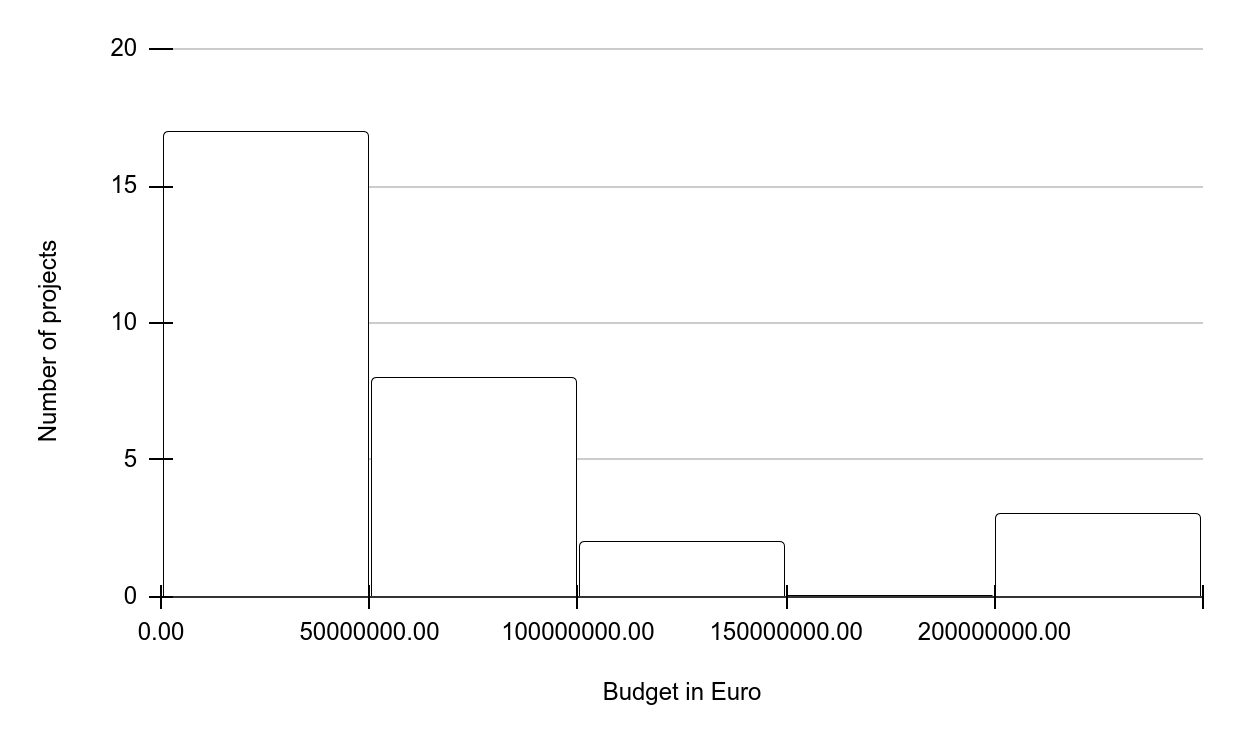
Looking at my estimated 1.7b Euro spent on around 30 projects across batteries, solar PV and wind turbines through the ETS Innovation Fund, the median project budget is 36m Euro with most below 50m Euro. But the telling point is that the TRL of projects cannot be known.
Histogram of project budgets in the ETS Innovation Fund across batteries, solar PV and wind turbines
One admittedly minority reading of the Northvolt collapse would be lack of sincere technology assessment whereby large sums were dedicated to projects on the hyped claim that they were high TRL when they, were, in fact, low TRL.
This mistake is certainly at risk of being repeated. TRL remains an important idea in EU policy rhetoric, as does inspiration from the US military-industrial complex where TRL originated, but the European bureaucracy does not seem to have systematized assessment. Rather, TRL is self-declared by project promoters and, worse, it is kept confidential.
The potential for political decisions to be “hidden” behind scientific-sounding quantities such as TRL is notably marked with projects dedicated to supporting fossil fuel incumbents such as ammonia which are evidently low TRL but are, instead, seen as sure wins.
While TRL offers a possible framework to resolve complications on the technical side, even if it is not being sincerely applied, there is no framework at all when it comes to financing, ownership and “chain of command”.
How, therefore, can officials conceive a program that combines such a diverse mix of firms including specialists, generalists, new and old, small and large, those with track records and those without, venture capital-backed, investment bank, privately-held, publicly-listed and cooperative (i.e., Mondragon)?
One possible answer lies in the connections between investment and societal values. Human ingenuity is best obtained on the broadest possible basis. S&T policy must evoke progressive emotions about a brighter tomorrow, not misanthropy. Gender balance, political neutrality, probity and competence of senior management teams would therefore be vital factors in the allocation of public funds.
Open source “tangible goods”
A subsidiary point arises as to where you want to instill competition as against cooperation, and if the latter, how you would manage rising complexity as the project scales. IP would perhaps be one of the notable issues in any such intentional program. The problem is that a world where devices like batteries are symbols of geopolitical power, and where innovations are deemed commercial and even state secrets, the space for “public interest” is limited.
One worry is that taxpayer funded R&D programs would shy away from topics that really matter due to fears over IP protection, focusing instead on peripheral issues. The prevailing atmosphere also closes down discussion of how manufacturing is changing and the progressive opportunities that lie therein.
Crowdsourced manufacturing [e.g., tank trailers] represents an emerging business model that establishes extensive connections with customer crowds and the manufacturing shop floor through a platform-based structure. This structure supports a diverse and large capability arsenal by maintaining a population of manufacturers and leveraging a crowdsourcing mechanism to extensively search for available solutions.
Gong, et al., 2025, Crowdsourced Manufacturing in Industry 4.0: Implications and Prospects, in: Systems
Stepping back, it is worth noting the history of wind turbines and solar energy, which has been both intimately tied to capitalism but often articulating progressive ideas about its reform. The latter concepts have always existed in the scientific literature (e.g. all-iron batteries and open source solar PV).
Exactly how we could incentivize such open source “tangible goods” in a targeted sector like wind turbines – within the inevitably broader context of capitalism – is as yet unresolved. But contemporary conceptions of IP are evidently mutable social constructs that have emerged over the past few decades.
Rear-view mirror
The above is perhaps different from the conventional ideal of EU science and industrial policy which was always quite simplistic about the epistemic sources of renewal. Was the question primarily concerned with unleashing supposed European “genius” or was there, in fact, no “genius” to unleash?
Historically-speaking , techno-nationalistic rhetoric, established above all in France and the UK with projects like the Concorde supersonic airliner, transformed into a supposedly pan-European doctrine that looked like “white supremacy with machines”. While ostensibly concerning only the NATO countries, in some notably utopian formulations (such as that of a prominent European Commission official, Christopher Layton), it called for collaboration with the Warsaw Pact as well. Commentators also regularly drew on stock declinist rhetoric that European supremacy was under threat but, tellingly, not from the Soviet Union, who they did not rate technologically.
The picture was, in turn, mixed with less overtly emotional ingredients, like the supposedly “pragmatic” market orientation of West Germany, embodied in policies such as those of the CDU science minister Heinz Riesenhuber. (A newer complication has been Spain’s joint-venture strategies which are often now raised as solutions to the rise of China.)
Whatever the antecedents, EU policies typically took concrete form by excluding firms associated with competitors, although it was often a grey area when it came to the USA but not with Japan, reflective of the patina of white supremacy. In historical cases, such as Airbus, but also substantial but less famous programs, e.g., the Joint European Sub-micron Silicon Initiative (JESSI), officials ultimately conceived a matrix of cooperative projects among firms “domiciled” in Europe.
JESSI is a success. European semiconductor companies have effectively caught up in terms of technology. JESSI has successfully catalysed the cooperation of companies and institutes in a whole range of microelectronics projects which have achieved, or are set to achieve, most of their technical goals in the areas of chipsets, design techniques, semiconductor technology and new equipment. The stage is now set to capitalise on the work of JESSI, adapting in the light of experience to convert excellent R&D results into strong market impact. But the pace at which microelectronics technology progresses necessitates ongoing efforts to maintain the achieved European position.
Assessment of JESSI PROGRAMME: European Report: Final report, European Commission, 1995
While these specific cases are rarely readable in simple terms, they seem often to have been framed, at base, by emotions, such as pride, tempered by myriad compromises, as much as any single logic. European officials might have been content merely that activities occurred across European borders, according to the over-arching narrative of European integration, even if economic effects were debatable.
Furthermore, all such frameworks were evidently established towards the end of the Cold War, concerned with “managing” economic interests among the Western bloc. The source of new ideas was at first the USA, later joined by Japan. Many older frameworks are not only dated but consigned to irrelevancy, given the Cold War finished and the Western bloc, for the moment at least, lacks the ideological potency it once had.
The supposed connections between senior government officials, “national” firms and “patriotism” that are central to techno-nationalism have long been questioned due to factors like corruption as well as the complex nature of loyalty in contemporary capitalism. A “French” firm does not necessarily act in the interests of the French people let alone higher ideals.
It is unclear how Europe’s weird accumulation of political economy would shape, and be shaped by, a country as dynamic as China but, of course, we are currently living through it. There are reasonable historical grounds to argue that China has, for a lot of history, been the primary wellspring of human ingenuity; based on this track record and assuming it could to some degree be extrapolated into the next decades, formulating effective science and industrial policy in Europe is therefore likely to require a new mindset.
If the broader context of ‘global technology ethics governance’ has changed, then the meaning of ‘China’s role’ has shifted as well. This shift is not reducible to an abstract narrative of ‘rise’; nor is it well captured by essentialist claims about civilization. What has changed more concretely is China’s position within global governance and the manner of its participation. On the one hand, China can no longer be understood simply as a passive recipient of global technological norms. On the other hand, the issue is equally one of how China’s own discourses and value frameworks come to matter within global settings. In an era defined by intensified geopolitical competition and the politicization of technology, China’s governance practices, institutional language, policy initiatives and cultural resources are increasingly entering the arena of global technology ethics debates. They are cited, questioned, misread and at times translated into new instruments of dialogue…In this respect, China’s significance in global technology governance lies not only in its institutional practices but also in the theoretical position increasingly assigned to it. From the perspective of intellectual history, the impulse among Western thinkers to ‘seek remedies in China’ is hardly new.
Lu Gao, 2026, Rethinking global technology governance at a crossroads: China’s role, historical turning points and future imaginaries, in: Cultures of Science
In this context, the “geopolitical turn in decarbonization” emanating from Western countries led by the USA is causing yet more confusion because it raises the temperature of even quite humdrum ideas. In 2020, Xi Jingping’s famous proposal on “carbon neutrality by 2060” was rejected by European leaders as grounds for cooperation, by teleconference of course, marking a notable low point on the part of the EU.
The EU high representative of that time, Josep Borrell, seemed to be moderately in favor of cooperation with China on green technology, based on public pronouncements, but he also appeared to make odd statements, comparing his idea of China to popular songs of his youth. For example, he used the term “Sinatra doctrine” for his China policies, while also citing inspiration in the “legendary song by Serge Gainsbourg, Je t’aime … moi non plus” which he took to signify “the feelings and contradictions that form part of the eternally difficult relations between couples”.
After Biden took office (2021), in keeping with the opinions of the US administration, Borrell seemingly took a more Sinophobic line. “Last week we discussed EU-China relations with EU Foreign Ministers and we agreed that there is no viable alternative to the triptych of treating simultaneously China as a partner, competitor and systemic rival, depending on the issue,” he wrote, in an op-ed bluntly entitled “How to deal with China”.
Unlike Borell, the current high representative, Kaja Kallas, has not to my knowledge published op-eds on the website of the EEAS. Nevertheless, old mindsets still seem to dominate many aspects of European policy discussion, perhaps because they are reassuring. The Draghi report (2024), for example, has aspects of the old “techno-nationalist” vision. It is presented as if it is new while, to the contrary, actually appearing similar to many decades of policy, as if making the same moves, but perhaps at higher intensity, would solve the problem. In this regard, amnesia is the first intellectual barrier for policy analysts to overcome.
| “Needham Question” European policy rhetoric is dominated by abstract concepts. The first rhetorical goal is “strategic autonomy” and “sovereignty”. While its advocates would probably deny they are talking about autarky, the denial only extends so far.The central argument seems to be that the EU can buck historical trends through what often amount to relatively minor adjustments in science and industrial policy. Besides the explicit Euro-centrism of official rhetoric, policy initiatives such as the European battery and solar alliances hinge on the epistemic basis of renewal lying mainly within continental borders. Looking at my own reading list, which is far from complete, “geoeconomics” experts Ban and Liu get to the general idea most clearly, citing their paper last year “The Emperor has No Batteries: Europe’s Uneven Bid for Battery Strategic Autonomy”. They argue that Europe could become “a competitive supplier of decarbonisation technologies…free from Asian supply chains” but only if officials made changes in working methods termed “green developmentalism” focused on “the long haul of scaling, stabilisation, and sovereign retention [of technology]”. A second, minority, view of decarbonization is that such a huge program of re-equipping the energy system could only be achieved through global partnerships. Glossing some of the underlying arguments, we could say that due to the long term consequences of decolonization and the rise of Asian economies such as China, South Korea and Taiwan in the later twentieth century and beyond, the old trans-Atlantic dispensation was no longer credible. This was not just for reasons of equity and shifting power relations, but because the explosion of ingenuity at global scale, long constrained by Western powers, had become the crucial dynamic force in technology and ought to be embraced. A third nuance across these varied arguments is “reluctant acceptance”. It is an acknowledgment that the supply chain is, to a considerable degree, in Asia and cannot be overturned. Outside of a time machine, re-shoring manufacturing and knowledge production as if it was 1960 is therefore impossible, for epistemic and other reasons. Furthermore, because of the fear of a zero-sum game developing in which Europe was the zero, European diplomats should strive for a more cooperative atmosphere internationally. The rhetorical mix is, overall, contradictory, in part reflecting differences in elite opinion across the continent. Perhaps there is a correlation between support of fossil fuel incumbency and hostility towards China, as against renewables and openness to cooperation with China, reflecting divides between reactionaries and progressives. |
Conclusion
How will the EU supply its own re-equipment program and how will cooperation with third countries be managed as this program plays out? The answer has to be mixed with shifting economic and political goals. The resulting jumble of moving parts makes everything complicated and will increase the difficulty of an already difficult reform program.
(It plays into directionless S&T diplomacy on the part of the EU. The recent EU “framework” on the topic is a perfect performance in saying nothing. The EEAS, furthermore, needs leadership with intellect, charm and human qualities of sincerity and warmth that would inspire interlocutors around the world to trust them.)
Many in the policy community will continue to focus on abstract rhetoric, rather than the detailed issues I raised above, for understandable reasons. But emphasis on supporting fossil fuel incumbency is the main problem. This is tangled with a lot of other matters. Revisions of European capitalism will be necessary but, currently, political leaders seem to struggle with even relatively incremental changes of the kind discussed above.
I would prefer a transparent approach spread mindfully over batteries, solar PV, wind turbines (and related distribution and control equipment), and which highlights the risks of different policy settings. It would consider what the economy and society ought to look like in a decade and then describe how that economy and society would fulfill its energy needs. This would help those trying to hold decision-makers to account. SET-Plan, the only document in existence that might gesture in such a direction, does not achieve it, either in principle or practice.
The American attack on Iran that started in late February 2026 has upturned policy discussions. American decisions are undoubtedly causing profound human suffering. But wider predictions about the energy system seem premature. The history of past oil shocks does not strongly support the idea of karma, i.e., spontaneous progressive change on the back of them.* Rather, we potentially face a complex pattern of outcomes which defy a single global story, but are likely to be unwelcome when it comes to Europe (although, again, varying in nature from country to country and region to region).
It is as if the [European] Commission were incapable of working out its own relationship with history, as if it were torn between two extremes: to vindicate itself by emphasizing the past, by harking back to the pioneering days; or alternatively, to erase the memory of periods of conflict, however, recent, once and for all… Driving without a rear-view mirror.
Abélès, et al., 1993, An Anthropological Approach to the European Commission (European Commission), p. 27
Notes:
Dr. William Burns PhD MSc
Email: william@resorg.news
 Science Think Tank