Science and technology are managed by those who win the struggle for meaning.
Adesanmi, 2012, Project Nigeria: The Struggle for Meaning, in: You’re Not a Country, Africa, p. 204
Summary
In 2023, when the most powerful politician in Africa, President Ramaphosa, addressed the most powerful politicians in Europe, concerning the need to do ‘something very practical’, why did he propose a giant dam when he could have proposed an Advanced Research Projects Agency?
The goal of this project has been to identify investment options that would underpin industrial R&D in the African Union (AU) over the next decade.
Through a process of reading, desk-based analysis, and communications with African scientists, the following five options emerged:
- An African Advanced Research Projects Agency
- A multipurpose network of research institutes
- A framework to influence overseas scientific institutions established in AU member states; full restitution of remaining colonial-era assets
- An African ‘Nobel Prize’ to promote achievements in the basic sciences*
- Strengthened science diplomacy capacity in strategic areas
These are not new proposals – some, indeed, have been around in various forms for decades; others are ‘in the air’ concerning what is already being discussed.
Overall cost of all five implemented simultaneously would be multiple billion US dollars. Less ambitious interventions could be delivered in the range of millions of dollars.
The first major cross-cutting obstacle is likely to be the international IP regime that favors the Global North. As currently positioned, it is a logical prediction that increased scientific activity in Africa, leading to increased scale and legibility of African IP, would not accrue commensurate benefits to African inventors.
That would be an untenable situation (as is widely-known). I have no solution for it other than to raise the paramount importance of finding one that is watertight before committing to many of the ideas proposed here.
The second axis obviously lies with funding.† The overall point is that relatively modest but sustained investment maintained through thick and thin is what would matter most.
Between IP protections and funding, strategizing must be stepped up among like-minded people in the science policy community, given the economic and political effects of climate and other crises mean the situation for science and research worsens.
Notes:
*Van and Ado, 2020, The African “Nobel Prize”: A Driver For Development?
†An overview of funding issues can be found in: UNECA, 2018, Towards Achieving the African Union’s recommendation of expenditure of 1% of GDP on Research and Development. My own analysis focuses on the political economy of national funding mechanisms such as Nigeria’s TETFund as well as the possibilities of commerce at the level of individual research institutes.
Africa science policy bibliography
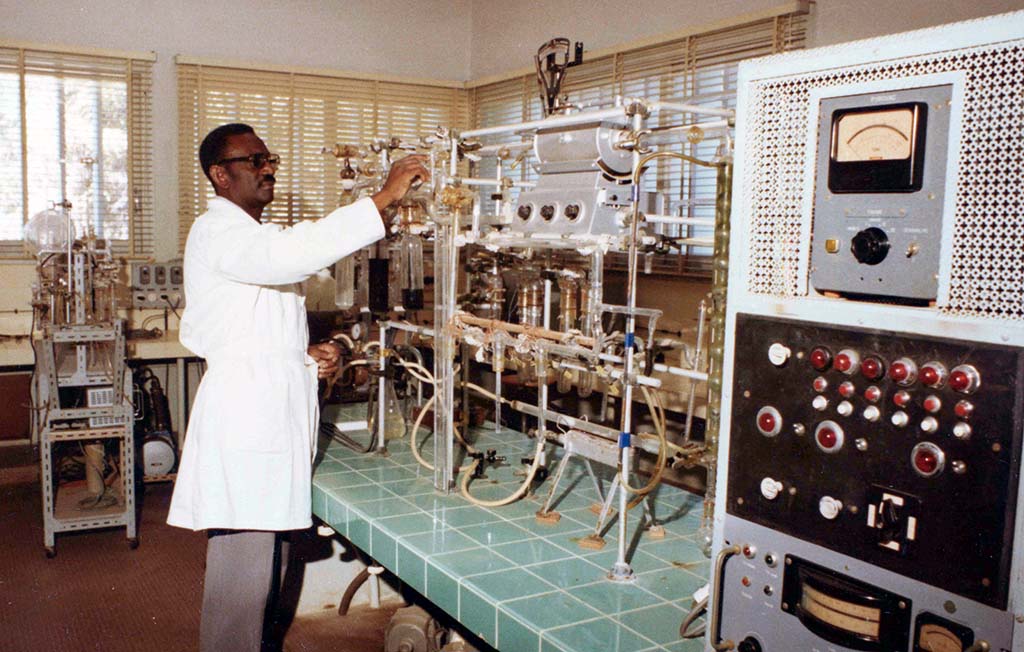
The header image shows Cheikh Anta Diop in the IFAN laboratory in Dakar in 1976. It is attributed to Jake Scott.
Please contact me if you would like to know more.
Dr. William Burns PhD MSc
Email: william@resorg.news
 Science Think Tank